

OUR  MISSION

No founder should stand alone.

This is the core mandate of our collective. Born from a people-for-people movement, our mission is to ensure that no individual creator, innovator, or builder is forced to stand alone against systemic overreach.

We are rallying a global alliance to protect those who engineer novel, world-changing technologies, ensuring that the future of human talent remains open, decentralized, and entirely in the hands of the people who build it.

NO FOUNDER SHOULD STAND ALONE  

Defend the Creators: We stand as a protective shield for independent visionaries who lack the multi-million-dollar war chests needed to survive protracted administrative warfare.  

Level the Playing Field: By pooling elite legal minds, strategic funding, and automated public relations, we break the isolation strategy traditionally used by massive regulatory bodies to force quiet capitulation.  

Preserve Innovation: We ensure that ground-breaking tech designed to democratize global leverage and bypass legacy gatekeepers can actually reach the world without being prematurely extinguished behind closed doors.

WHAT WE STAND foR

Four things we will not budge on.

Two yellow arrows forming a loop pointing left and right on a dark background.

Rule of law

We stand for the rule of law, and we believe in it. We fully support Chairman Atkins and his progressive, back-to-basics vision for the Commission. A strong, principled regulator acting on clear frameworks is the ultimate ally of every honest builder

Two yellow arrows forming a loop pointing left and right on a dark background.

Due process

Every founder deserves to be heard before they are harmed. Our fight is not with the Commission or its leadership — it is with a rogue Division of Enforcement in New York that has turned administrative process into a weapon, actively opposing the new mandate and principles laid down by the Commission itself. Due process should be an absolute guarantee, not a negotiation.

Yellow book icon with lines representing text.

The public record

Transparency is the best discipline. We refuse to cut quiet deals in the dark. We make our case entirely in the open, where it can be tested, critiqued, and verified by anyone.

Minimalist gold line art of a mother holding a baby wrapped in her arms.

Good faith

We build by the rules and answer honestly. We expect the exact same in return from everyone—including the civil servants tasked with enforcement.

Stronger Together:  One founder, alone, is vulnerable.
A Coalition: Standing in the plight, is unassailable.

THE FIRST STAND

“One founder. One fight. With  A REVOLUTION AT HIS BACK.”

This is the story of a global network of builders who refused to let an entirely novel technology be quietly extinguished. When institutional overreach attempted to isolate and crush that vision, it didn’t find a Founder willing to buy his way out or compromise. It found a definitive, precedent-setting stand.

THE TECH‍
TheXchange set out to build a global financial infrastructure designed entirely to democratize human talent. By developing the VirtualStaX ecosystem, the team engineered a frictionless digital highway allowing athletes, musicians, and creators worldwide to monetize their own potential, letting global audiences back their dreams directly. It is a masterclass in compliance-first software engineering, intentionally structured to bypass legacy gatekeepers.

THE MOMENTUM
The vision quickly commanded a powerful global stage, rallying some of the world’s most iconic sports figures and cultural leaders as global ambassadors. Backed by this unprecedented coalition, the team spent months aligning international banking rails and finalizing enterprise-grade systems for a definitive, large-scale launch. The infrastructure was validated, and the project possessed massive global momentum.

THE AMBUSH

Then came the friction. Weeks before the scheduled rollout, the SEC’s New York Division of Enforcement introduced an administrative attack with a singular purpose: to exhaust the venture’s resources and force a quiet capitulation behind closed doors. There was no consumer harm, no user complaints, and zero administrative due process. When settlement negotiations broke down because the Founder refused to admit wrongdoing where none existed - and refused to pay astronomical fees while the Division systematically withheld crucial case details -the agency issued a Wells notice. It was a clear attempt to weaponize the clock, running out the venture's capital until it folded.
‍
THE CHOICE
‍
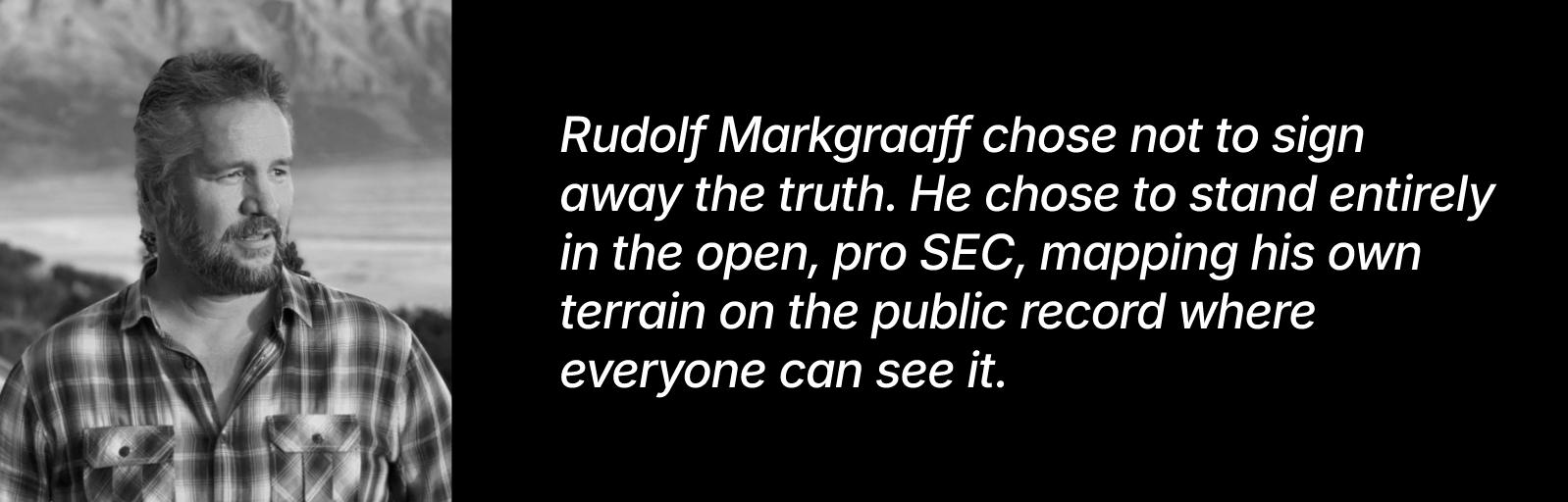
Rudolf Markgraaff refused to comply with the script. Stripped of operational assets and facing the full weight of a federal apparatus alone, the Founder of this Coalition chose to draw a line in the sand. He stood entirely in the open on the public record, representing himself pro se rather than signing away the truth.

His choice to fight back transforms this case into a vital precedent—proving that the isolation strategy only works when builders choose to hide. For those looking to verify the depth of this overreach, the complete battle lines are laid bare in the primary filings.

📥 DOWNLOAD THE FEDERAL CLAIM & EXECUTIVE SUMMARY

Read the full structural layout of the case, the underlying record, and the exact legal mechanisms being used to dismantle this administrative ambush.

Why the Honey Badger?

Small. Fearless. Tenacious.
The honey badger does not measure the odds.

If you look only at the metrics, he makes no sense. He possesses no great stature, no blinding speed, and no majestic mane. He is one of the smallest predators on the African plain—known locally in Afrikaans as the Ratel. Yet, the animal kingdom hands him a title none of the apex giants can claim: the most fearless creature alive.

The physics of his design are a masterclass in survival. For his size, his physical strength is unmatched—a bite force capable of crushing bone, claws as long as an eagle’s talons, and a thick, rubbery hide that shrugs off the sharpest strikes or the fangs of a king cobra. If a predator bites into him, the badger can entirely turn around inside his own skin to bite back.

But his true weapon is not structural. It is psychological. It is his temperament. He does not calculate probabilities, and he never backs down.

Most days, he is a peaceful presence, asking only for an open path to build, dig, find a little honey and move forward. But corner him, or threaten his territory, and he explodes into a decisive, hyper-focused ball of fury. A single badger routinely puts an entire pride of apex lions to flight. He does not achieve this by out-sizing the competition; he achieves it by making the cost of engagement unacceptably, painfully high.

Eventually, the giants learn a fundamental rule of the plain: It is cheaper to simply step aside.

The Band of Badgers

The Founders Coalition was built on that exact biological principle.

The entrepreneur who engineered TheXchange and developed the VirtualStaX platform navigated the corporate and regulatory machinery with that exact same defiance. To those who watched him refuse to buy his way out of an administrative ambush, he became known as “The Bad Badger.”

When targeted by an institutional machine relying on isolation and financial exhaustion, he made a quiet, unshakeable vow never to fold—and quickly realized he was far from alone. Thousands of independent builders were being quietly crushed behind closed doors by the exact same playbook.

To shift the balance of power, he structured a counter-strategy built on three precise, asymmetric pillars:
Read more

The traditional institutional playbook relies on a single variable: isolation. They expect a lone creator to look at the sheer scale of a federal agency, do the math, and quietly capitulate before anyone else can see the fight.

But a coordinated band of badgers changes the ecosystem entirely. The isolation strategy is officially broken. From this point forward, no independent founder has to face the machine alone.

If a single badger can make a pack of lions retreat, a coordinated band of badgers changes the ecosystem entirely.

The Founders Coalition is here to stay. The isolation strategy is officially broken, and from this point forward, no independent founder has to face the machine alone.
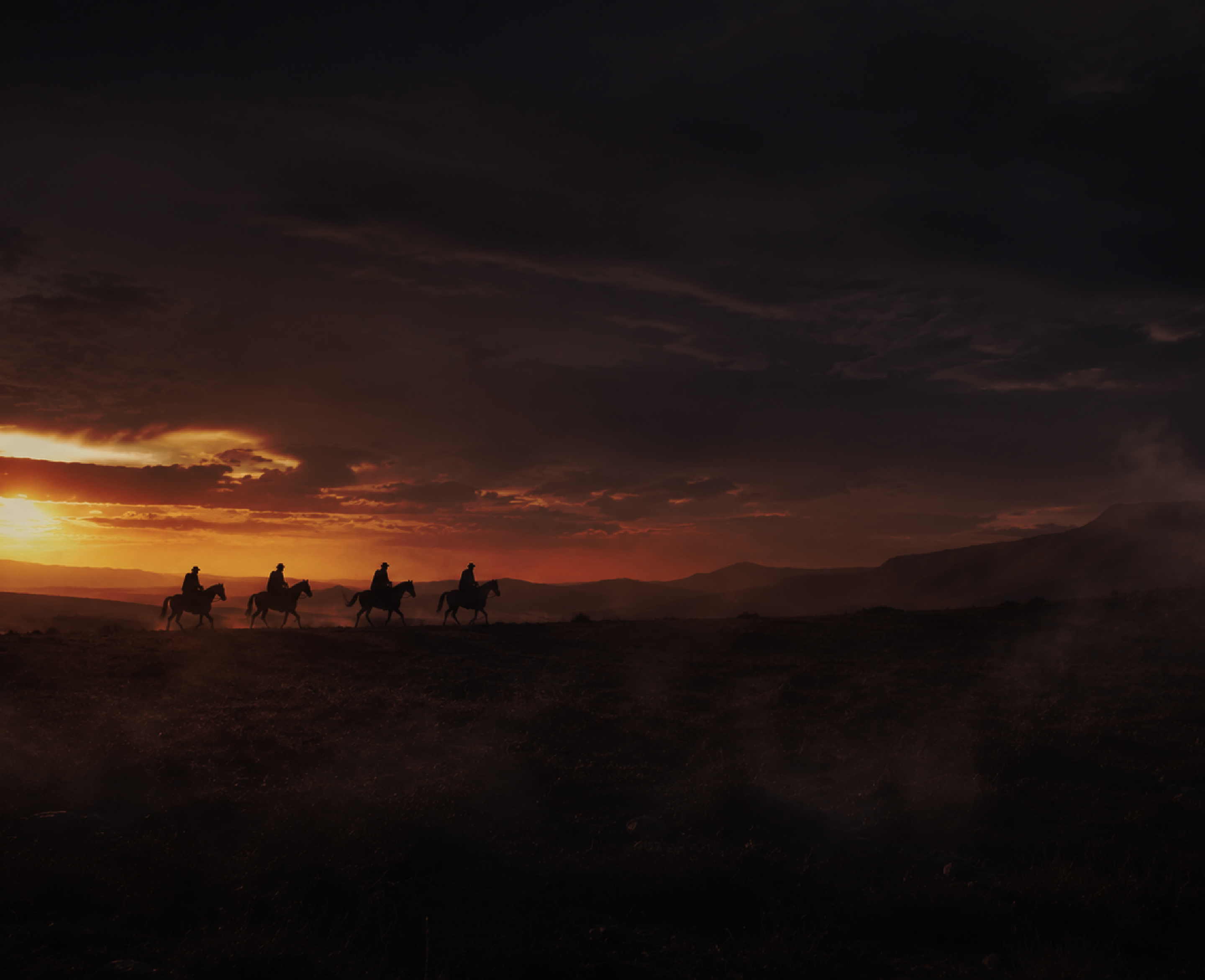

The Fighting General

General Christiaan Rudolf de Wet, 
the Three Years’ War of attrition that broke an empire’s will.

On the high, open veld of South Africa, a free people once stood against the largest empire on earth — and would not break. By numbers they should have lost in a single season. They did not lose, because the man who led them understood something the empire never did: you do not have to be bigger than your enemy. You have to be impossible to finish.
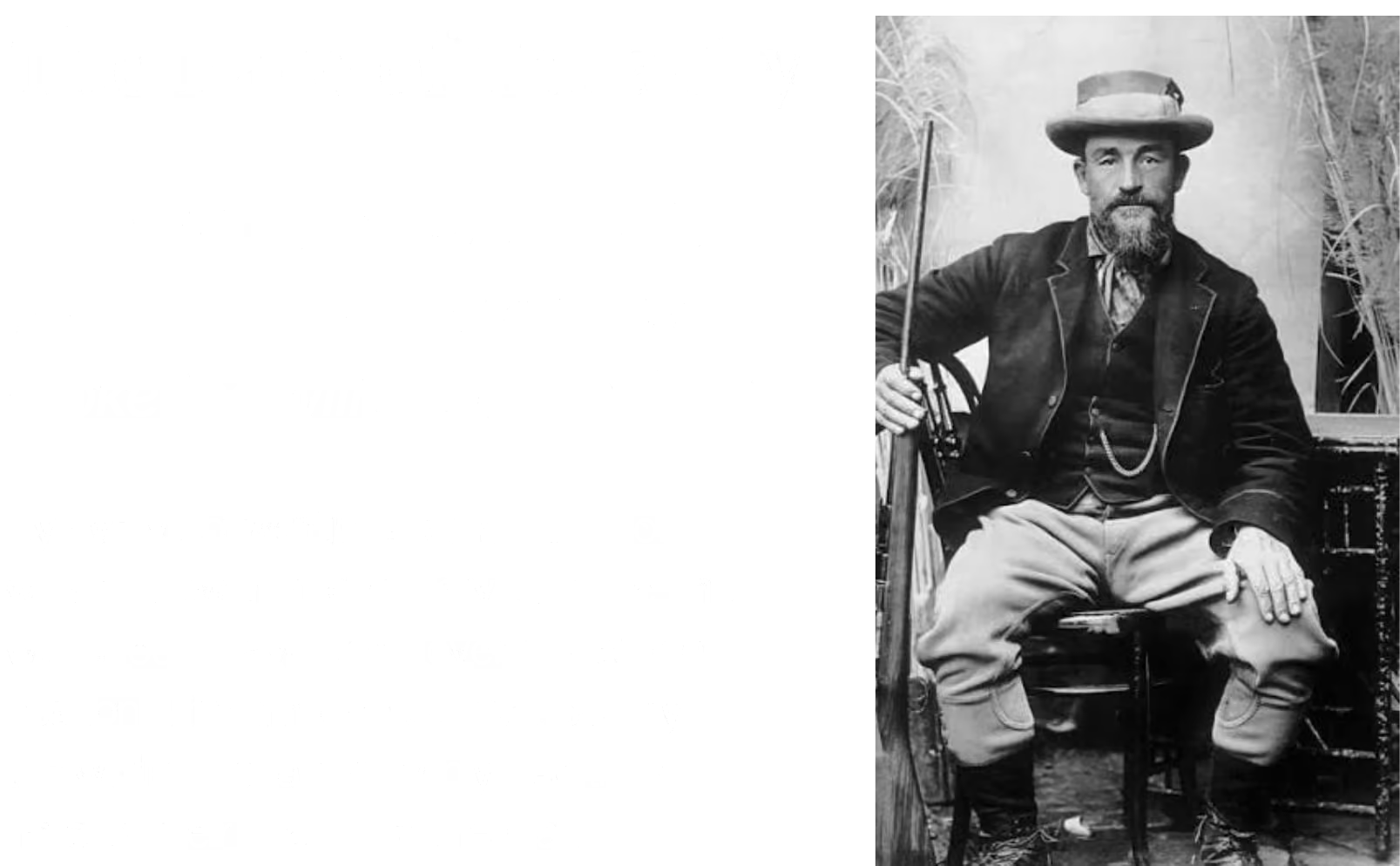
The Face of Tenacity

“The ultimate asymmetric force: a humble farmer who broke the will of an empire.”

By every conventional calculation of wealth, power, and military doctrine, the war should have been over in a single season. The empire had the treasury of the world; the farmers only had their horses, their rifles, and their faith.
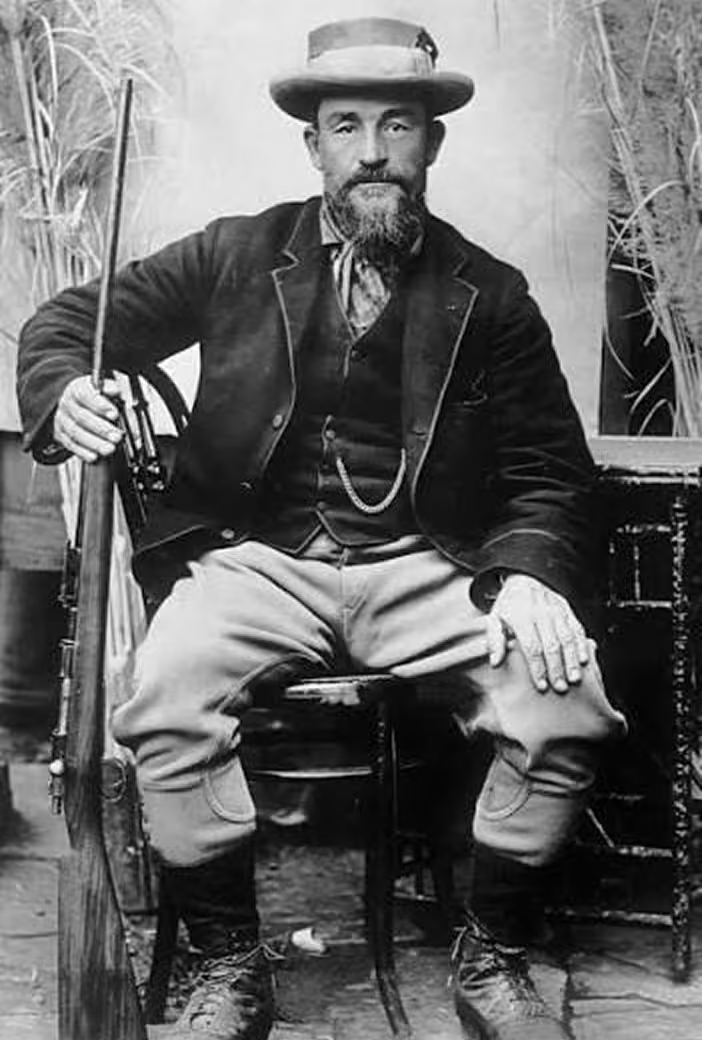
However, the empire didn’t understand the terrain, and they didn’t understand the man who was about to rewrite the physics of conflict. His name was Christiaan Rudolf de Wet.

‍
THE FIRST LESSON

‍
To understand the General, you have to understand where the fire was lit. Two decades before the great British invasion of South Africa, in February 1881, a young De Wet stood as an ordinary field-cornet on the steep, rocky slopes of Majuba Hill.

He watched a British army march up that mountain in perfect, arrogant formation—bright red tunics against the green grass, moving in straight lines, trusting entirely in their numbers and their manual of arms.

‍

Black and white photo of soldiers crouching and aiming rifles in a line on open terrain.

‍

They were met by a handful of South African farmers who knew the lay of the land, how to shoot straight and make every single bullet count. In a matter of hours, the farmers shattered the imperial force and sent them retreating down the mountain.

De Wet left Majuba Hill with a permanent, burning truth seared into his mind: A massive, well-funded machine operating on rigid, predictable playbooks is profoundly vulnerable to free people who know the terrain, refuse to panic, and refuse to play by the machine’s rules.

‍

THE EMPIRE RETURNS

‍
By October 1899, the British Empire returned to settle the score. The catalyst wasn't just pride; it was gold. The richest reef on earth had been struck right beneath the Boers’ feet on the Witwatersrand. An empire beaten once does not forget a grudge, especially when there is immense wealth to be seized.

When the call to arms went out across the plains, De Wet rode out as an ordinary burgher, his seven sons by his side. He carried no official rank and asked for none. He was a humble man, a farmer who preferred the quiet of the soil.

‍

Black-and-white photo of a large early 20th-century steamship docked with people on deck.

‍

But in an asymmetric crisis, true leadership is not appointed by a committee; it is recognized by the men in the mud. Men naturally look to the person who does not flinch when the artillery starts to fall. Within months, by sheer force of character and tactical brilliance, he was elected vice-commandant, and soon after, named a fighting general.

He looked at the overwhelming wave of red uniforms spilling across his country and realized a hard truth: if they fought the way the empire wanted them to fight, they would be extinguished. So, he chose a different path. He didn't fight to win conventional battles. He fought to wage a war of attrition.

‍

REFUSING THE BAIT

‍
When the British massed their forces and captured the capital cities of Bloemfontein and Pretoria, the empire celebrated, believing the war was won. A proud, traditional commander would have lined his men up for a grand, tragic stand to defend the buildings.

De Wet refused the bait. He knew that a head-on collision was exactly what the machine wanted—a meat grinder where wealth and raw numbers always win. Instead, he turned his back on the capitals and took to the open veld.

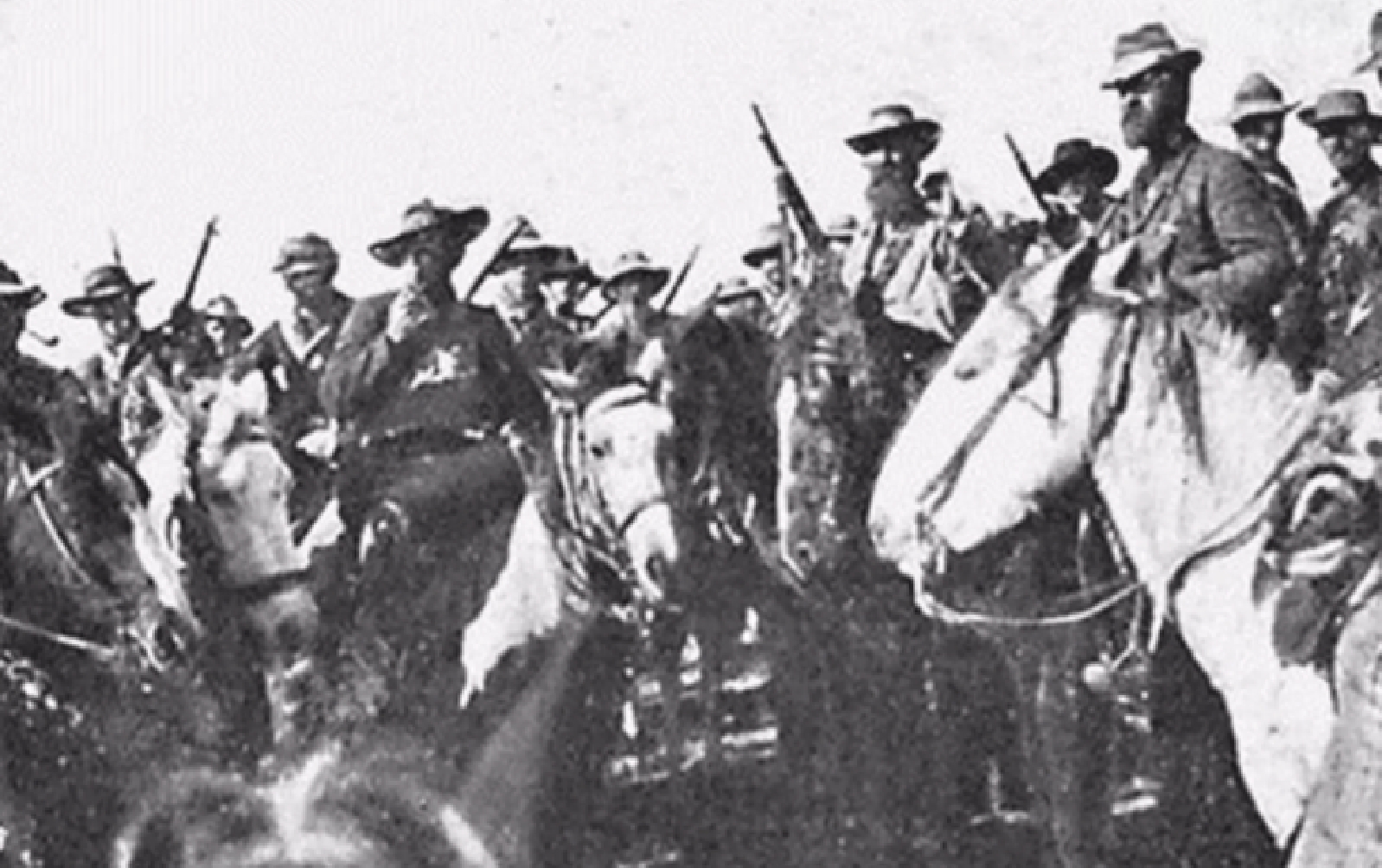
His new doctrine was elegant in its simplicity: never meet force with force. Where the empire was heavy, De Wet was light. Where they were slow, he was already gone. He broke his forces into small, highly mobile equestrian units—the world's first modern guerrilla commandos.

They attacked the empire’s vulnerabilities. They blew up supply trains, cut telegraph lines, and ambushed isolated columns from angles the British manuals said were impossible. By the time the imperial artillery could unlimber and turn around, the commandos had vanished back into the vastness of the plain.

The goal wasn’t to annihilate the British army in a single day; it was to make the cost of engagement politically, financially, and morally unbearable for them. He wanted to make the machine exhaust itself.

‍

Black and white photo of a group of armed men on horses wearing hats and military-style clothing.

‍

THE KROONSTAD WATERSHED

‍
By March 1900, the old way of fighting was delivering disaster. A senior Boer general, Cronjé, had just been surrounded and captured with thousands of men at Paardeberg. Why? Because he refused to abandon his massive, slow-moving train of four hundred ox-wagons. He was weighed down by his own baggage.

De Wet called a council of war in the town of Kroonstad. He walked into the room and drew a definitive line in the sand: No more wagons. No more baggage. No more slow, defensive camps. From this day forward, we travel with nothing but our horses, our rifles, and the clothes on our backs.

Then, he did something that looked like absolute tactical madness. He looked at his exhausted, demoralized men and sent them all home. He told them to ride back to their farms, see their families, recover their spirits, and meet him at the Sand River in one week.

The older, traditional generals panicked. They accused him of abandoning the field. But De Wet understood human nature deeply. He looked at them and said: "I cannot catch a hare with unwilling dogs."

He trusted them. And his trust was rewarded. A week later, the men returned in greater numbers than before, their eyes clear, with a single word on their lips: Forward!

Two weeks after that, at Sanna’s Post, the new doctrine proved its brilliance. With just 1,500 horsemen, De Wet laid a completely silent ambush at a river drift just outside the capital. He didn't fire a shot until the British column was entirely inside the trap. Without a bloody battle in the open, he captured 117 supply wagons, over 400 prisoners, and seized the waterworks feeding the British garrison. It was bloodless, brilliant, and perfectly asymmetric.


SCORCHED EARTH

‍
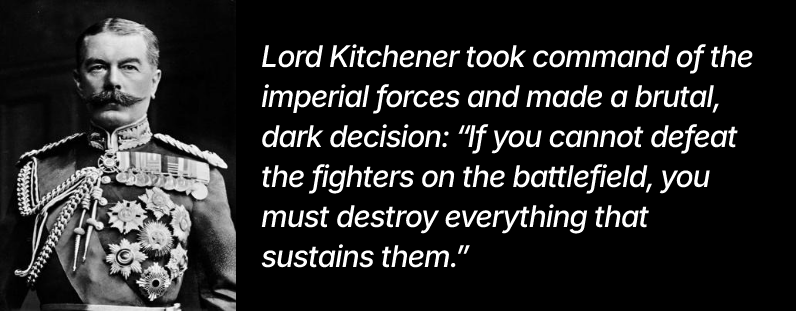
Frustrated by an invisible enemy they could neither see nor catch, the British Empire grew desperate. The war was costing the British treasury millions of pounds a month, and the public back home was getting restless.

‍

Portrait of Lord Kitchener in military uniform next to a quote about defeating fighters by destroying their support.

‍

The empire turned its massive weight away from the commandos and onto the defenseless. They launched a total scorched-earth campaign. Over 30,000 farmhouses were systematically burned to ash. Fields were salted, wells were poisoned, crops were torched, and millions of sheep and cattle were slaughtered and left to rot in the sun.

Then came the invention that would stain the history of the modern world: the concentration camp.

‍

Wide view of many conical tents set up on barren land with a few people walking among them.

‍

Tens of thousands of Boer women, children, and native South Africans were dragged from their burning homes with only the clothes on their backs, packed into open cattle trucks, and moved to squalid, disease-ridden tent cities. Rations were deliberately halved for families whose husbands and fathers were still out on commando.

The human cost was catastrophic. More than 36,000 Boer women and children died in those camps—and four out of every five of the dead were children, the majority from starvation.

‍

Black and white photos of three severely malnourished children in different settings.

‍

The empire thought the dark would hide this. But an Englishwoman named Emily Hobhouse traveled to South Africa, forced her way into the camps, and took meticulous notes. She carried the raw, unvarnished truth back to London, exposing the horror to the world. The light of public record began to crack the empire's moral authority from within.

‍

THE AGGRESSION THAT FORGED THE RESISTANCE

‍
The British strategists assumed that destroying a man's home and locking up his family would break his will to fight. They completely miscalculated the psychological leverage of a righteous man.

By burning the farms, the empire inadvertently stripped the commandos of the one thing that might have made them quit: something left to lose. The fighters no longer had property to defend or homes to protect. The cruelty did not soften them; it hardened them. It forged scattered groups of farmers into a single, hyper-focused, unbreakable brotherhood with nothing left but their cause, their faith, and each other. The aggressor, reaching for a swift and cheap surrender, manufactured the exact internal resolve that would ensure their own ruin.

‍

Black-and-white illustration of men on horseback and a cannon in a chaotic battle scene.

‍

THE DE WET HUNT

‍
The British military apparatus became entirely obsessed with a single individual. The campaign became known across the world as the "De Wet Hunt."

They deployed over 50,000 troops, built an intricate network of thousands of steel blockhouses, and strung miles of barbed wire across the continent for one solitary purpose: Catch General Christiaan Rudolf de Wet.

They never did.

Every time the massive imperial net drew tight, De Wet and his dwindling band of a few hundred ragged horsemen slipped through the gaps in the dark, leaving the empire closing its fist on dust. He moved like water through the folds of the land he knew so well, making the world’s most powerful army look slow, blind, and fundamentally foolish.

‍

WHERE THE POWER CAME FROM

‍
On paper, the spreadsheets and the muster-rolls said De Wet should have been crushed in weeks. But the spreadsheets missed his internal engine.

De Wet was a deeply humble, God-fearing man. He read his Bible in the saddle by the light of the campfire. He didn't look at the size of the enemy to decide whether he had hope; he looked at the righteousness of his cause to know he would prevail.

His absolute fearlessness came from a simple, unshakeable premise: If you fear God, you cannot be frightened by men, machines, or empires. He believed that if God was for them, the numbers didn't matter. That absolute certainty passed from his eyes into the hearts of his men. A single leader's conviction carried thousands through the dark.

‍

THE PEACE FORCED ON AN EMPIRE

‍
The war did not end with De Wet being brought to his knees in the field. The field never broke him. It ended because the empire simply could no longer afford to keep hunting the Badger.

‍

Black and white illustration of men in formal attire gathered around a table mid-discussion.

‍

Exhausted by an endless guerrilla campaign that they could not contain, bleeding millions of pounds a week, and facing immense global shame from the public exposure of the camps, Great Britain was forced to invite the farmers to the negotiating table.

On May 31, 1902, the Treaty of Vereeniging was signed. The republics compromised on formal independence to stop the slaughter of their children, but they were never conquered. They had forced the world's greatest superpower to reckon with them on equal terms. Within eight years, the British were gone, those very same farmers sat in the joint government, and the modern nation of South Africa was born.

They had outlasted the machine.

‍

A NEW FIELD, THE SAME FIGHT

‍
History operates in loops. The names change, the terrain shifts, but the playbook remains exactly the same.

Today, almost three years into a different kind of warfare, Rudolf Dewet Markgraaff—the great-grandson of General Christiaan Rudolf de Wet—is standing on a new kind of plain, facing a new kind of aggressor.

The Division of Enforcement has deployed its own version of the imperial playbook. A regulatory process designed to protect people has been turned into an administrative weapon of exhaustion. The strategy is classic: isolate the founder, cut off their operational assets, compound the legal costs over years of deliberate delay, and use sheer financial and psychological friction to force a quiet capitulation behind closed doors. They expect a lone builder to look at the multi-billion-dollar scale of the federal machine, do the math, and fold.

But they have run the old script on the wrong bloodline.

Just like on the veld, intense institutional overreach directed at a person of deep faith and relentless tenacity does not break the spirit—it strips away the noise. It forces a new kind of asymmetric defense into existence.

‍

Black and white photo of a bearded man in a plaid shirt looking left by a mountainous landscape.

‍

The Founders Coalition is the modern commando unit. We are pooling elite legal minds, decentralized funding, and an automated AI media engine to ensure that no builder has to face the machine alone. The isolation strategy is officially broken. We are dragging the facts out of the dark and into the sunlight.

The lions think the plain belongs to them. The empire thought so too.

The Badger knows.

‍
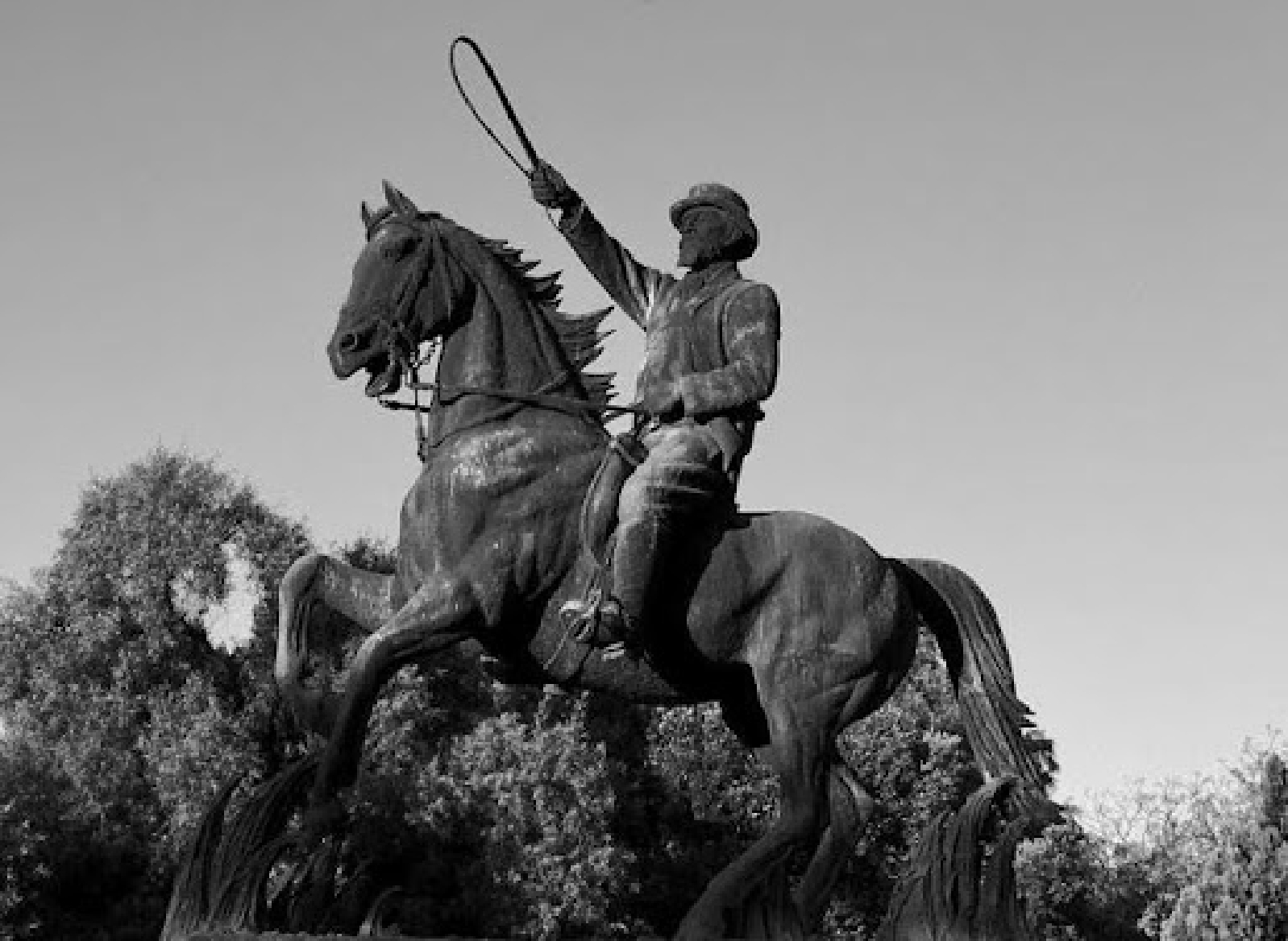
He sits immortalized in bronze outside the war museum in Bloemfontein—mounted on his horse, a whip held firmly in his hand, looking out over the free plain he refused to surrender.

‍

Bronze statue of a man on a rearing horse holding a whip in his raised right hand.

‍

General Christiaan Rudolf de Wet was the ultimate asymmetric force: a humble farmer who feared nothing but his Creator, a brilliant tactician who mastered the terrain, and a leader whose absolute tenacity broke the will of an empire. He proved forever that numbers do not dictate destiny when a righteous man draws a line in the sand.

“If God is for us, who can be against us?”
– The Fighting General.
Read less

join the founders coalition

Thank you! Your submission has been received!
Oops! Something went wrong while submitting the form.